On 26 and 27 October 2025, I was the guest of COPS-Metro in San Antonio and joined them to celebrate 50 very impressive years of local organising. This is a reflection on their work and how it could apply to our organising in the UK.
‘Markets were made to serve us; we were not made to serve markets. Economics needs ethics. Markets do not survive by market forces alone. They depend on respect for the people affected by our decisions’ Rabbi Jonathan Sacks
Twenty five years ago, Citizens UK built the Living Wage campaign. It has since resulted in over 16,000 organisations paying the ethical rate and the Living Wage Foundation, which has played such a key role in building the Living Wage movement. But, other than some notable exceptions, we have not made organising to curb corporate excess a key part of our strategy in the past decade. For most of the 12 years of my organising, I have primarily targeted underfunded local UK councils, the NHS and regional/national government, with a few campaigns to get businesses to pay the Living Wage. But with inequality growing, and the ‘top fifth taking 36% of the country’s income and 63% of the country’s wealth, while the bottom fifth have only 8% of the income and only 0.5% of the wealth,’ perhaps it is time to begin targeting those ‘bad apple’ corporations that are exploiting our people.[1] Doing so would enable us to play our part in ensuring that the market has a respected place in the UK for its role in innovation, creativity, collaboration, good job creation, skills investment and opportunities to support communities to thrive. At the same time, corporate campaigns could weed out firms that are becoming parasitic, exploitative or trying to take over fundamental roles of the state and create checks and balances that ensure accountability (Mondros and Mineiri, Organising for Power and Empowerment, 2nd Ed, pp 39-44).

COPS-Metro gave me new inspiration of what broad based organising can achieve in an era of unaccountable corporate power. Broad based organising in the USA has a history of taking on corporate power – taking on racist lending practices from banks (called redlining) or the famous stories of Saul Alinsky and the Kodak company. But a new version is emerging. For their 50 year celebration, they laid out a plan to stop £2 billion in tax breaks to fund a new stadium for the billionaire-owned San Antonio Spurs basketball team. The 1350 leaders who joined the action engaged a range of decision makers and articulated a vision of what they wanted to spend £2 billion on – new flood defences, pavements, improved parks and neighbourhood safety. Particularly powerful were the 75 civic academies that leaders ran within their organisations for the past 3 months, supporting people to understand the complex issues around tax subsidies, ownership structures and how to counter the arguments of the very expensive advert campaign of the billionaire Spurs owners. Leaders then committed to turning out 20,000 people to the polls to vote against ‘Prop B’ on 4 November 2025.
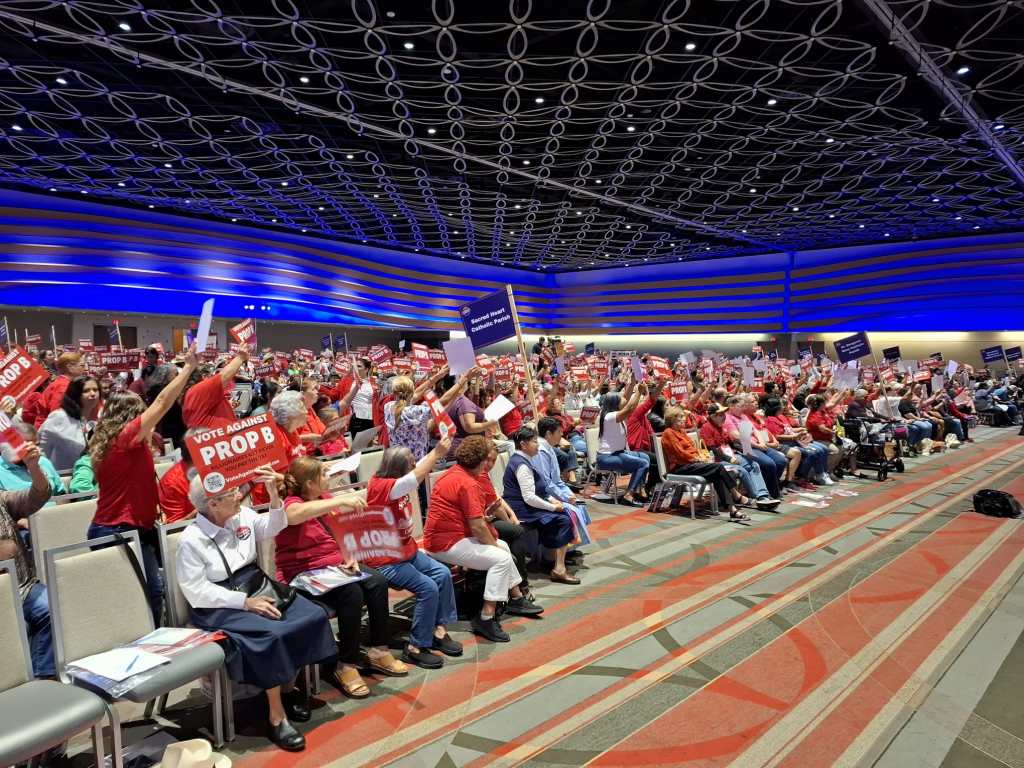
Private interests are playing a bigger role across Britain – for example within the NHS, water, schools and social care. But it pales in comparison to the USA, where companies are taking over huge parts of the economy previously performed by the state – prisons, healthcare, transport, military contractors amongst others. As the power of corporations grow in the USA, so too has the anger at the billionaire owners of these companies and the desire to challenge their increasingly unchecked power. Corporations increase in size, force out competitors and then change the rules to benefit themselves rather than facing competition from new entrants. Moreover, as firms play a bigger role in the state, they can drive down quality to run services that only seek to maximise profit.
In ‘The Captured Economy’, Brink Lesley and Steven Teles argue that this creates even deeper concentrations of wealth and power as economic rents[i] accrue to fewer and fewer firms.[2]
Here are a few reasons why this is a good moment to build corporate campaigns:
- It can build power across a greater area – Companies don’t only operate in 1 borough or city. We can build power as big and wide as the reach of the company. They also generate lots of energy and can help to build the power of an alliance. It is also a way to change the power dynamics between those who have a lot of power and those who have very little. Due to the anger of the exploitation many of these companies face, there are many new leaders who want to participate in these campaigns, providing many opportunities for leadership development and relationship building. In addition, sometimes, specific corporations are financing/supporting a number of issues across a range of issues, so we can build broader kinds of coalitions to combat their practices. And then, we would need to learn what long term corporate accountability could look like.
- Bad actors are having a material impact on our communities – Here are some examples – Clear Spring Homes, which runs housing for asylum seekers, is extracting £180 million in profits while delivering inedible food and rationing loo paper; Thames Water, which is increasing what it charges for water while pumping sewerage into our rivers and children’s social care, where, in 2022, private providers made more than £300 million.
- Political education – Corporate campaigns can sharpen leader knowledge about how power operates in our society and can help leaders to articulate a our vision for what society they want to build and what public money should be used for.
- Relationships between corporates, the state and civil society can lead to bigger changes than each alone – Mazzacato suggests that it possible to fight for policies from the state and find willing partners in the business community that can marshall the market towards collective missions that drive up competition and push society in a more egalitarian direction.[3] Look no further than the 25 year history of the Living Wage Campaign in the UK, even with all of its caveats – see this brilliant piece by veteran organiser Jonathan Lange about the limits to winning Living Wage campaigns on behalf of workers. There are some corporates that may value a long term relationship with Citizens. We can offer access to every day people; help develop their mission, create brand cut through and develop a new base for them with younger people who care about values. In addition, we may find ways to ally together on certain campaigns when they understand that we have no permanent friends and no permanent enemies – just issues.

In London Citizens, we are trying to rebuild our ability to hold corporates to account through our campaign on Thames Water, a company valued at over £20 billion. England is one of the only countries in the world to operate a privatised water system and it has led to this company’s owners and shareholders, since 1989, to withdraw over £24 billion in profits that should have been invested in the water network of Thames’ 12 million customers. This has led to massive sewerage spills in the Thames River, spiralling costs and huge amounts of anger amongst a range of people in London and across the South East. Which is why we are taking action on 5 November 2025 when we join with a number of other partners outside the DEFRA offices to call on the Secretary of State for DEFRA, Emma Reynolds MP, to put Thames Water into a Special Administration Regime (SAR). SAR will enable the Minister to ensure that Thames can clean up its act, invest in the network, bring down bills and recommit to Net Zero – see here for our briefing. We will write up our subsequent learnings and reflections over the next few months, but we hope to join with other alliances and organising outfits to rebuild corporate accountability.
[1] https://equalitytrust.org.uk/scale-economic-inequality-uk/#wealthinequality
[2] https://drive.google.com/drive/u/0/recent
[3] Mazzucato – Mazzucato, Mariana – Mission-oriented Policies – Google Drive
[i] ‘Economic rent’ can be broadly defined as income derived from ownership or control over a limited asset or resource. Such income is attained without any expenditure or effort on behalf of the resource holder. For instance, corporations like Google, Facebook and Twitter make money essentially by enabling advertisers to reach more quickly their target audience by selling information freely provided by their users – https://www.ucl.ac.uk/bartlett/public-purpose/policy/economic-rents
 The Iron Rule