The story of the 1955 Montgomery Bus Boycott is often told as a story of courage, sacrifice and collective action. After the trained community organiser Rosa Parks’ refusal to give up her seat in a planned action, Black residents of Montgomery organised a year-long boycott of the city’s buses, challenging a system that humiliated and oppressed them every day. It became one of the defining campaigns of the Civil Rights Movement.
But viewed through the lens of the “three faces of power”, as retold by veteran organiser Marshall Ganz building on the work of Stephen Lukes and John Gaventa, the boycott offers another lesson: lasting change requires us to organise across multiple levels of power, not just the most visible one.
Face One: Who Is Winning and Losing Today?
The first face of power asks a simple question: who is benefiting and who is suffering right now?
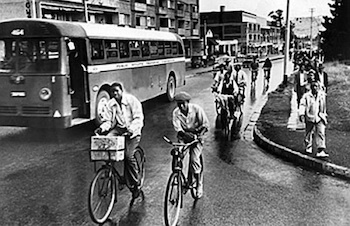
In Montgomery, the answer was obvious. Black residents depended on buses but were forced to sit at the back, give up seats to white passengers and endure daily indignity. People were hurting, and organisers responded to that immediate pain.
The boycott was a classic ‘face-one’ campaign. It identified a concrete injustice, created a specific demand (desegregation on Montgomery buses), had a target (bus companies), mobilised those affected and demanded change. This is often where community organising is at its strongest. Organisations like Citizens UK are frequently at their best when helping people act on the issues they experience directly: unaffordable bus fares, poor housing, unsafe streets or inadequate flood defences.
‘Face-one’ organising matters because people cannot wait for grand theories of social transformation. They need relief from injustice now.
Face Two: Who Gets to Decide?
The second face of power asks a deeper question: who decides that this situation is acceptable in the first place?
In Montgomery, segregation on buses was not simply the result of bad behaviour by a bus company. It was embedded in law, supported by political institutions and enforced across society. Winning improvements on a single route or with a single operator would never have been enough. The larger challenge was changing the systems and institutions that authorised segregation.
This is where many campaigns stop short, especially those that only focus on ‘face one’ issues. If we focus only on immediate wins, we can neglect the structures that create the problem. We might improve conditions temporarily while leaving the wider system intact.
For example, a successful local bus campaign might reduce fares or save a route. But if we never ask who controls transport funding, whose interests shape transport policy or how decisions are made nationally, we remain vulnerable. The next budget, election or policy change can reverse our gains, forcing us to start all over again.
Face Three: Who Benefits from the System?
The third face of power is deeper still. It asks who benefits from the existence of the system itself.
Segregation was not only a set of discriminatory laws. It was a racial order that advantaged some people while disadvantaging others. To challenge segregation fully meant addressing the beliefs, interests and institutions that sustained it across every area of life.
The genius of the Montgomery Bus Boycott was that it did not remain solely a dispute about buses. It became part of a much wider challenge to segregation as a social system. What began as a face-one struggle created the relationships, leaders and public narrative needed to advance work at faces two and three.
The buses were the entry point. The goal became much larger.
The Limits of Face-One Organising
This points to an important challenge for organisations like Citizens UK and many other broad-based organising groups.
Often we focus on face one. We identify people in pain, help them act collectively and win practical improvements. That work is essential.
But there is a risk that we become so focused on immediate issues that we stop asking the larger questions. What systems create poor housing? Who profits from high energy bills? What economic and political forces drive climate change?
Take climate organising. Winning better insulation for social housing tenants matters enormously. It can reduce bills and improve health. But if we never connect that campaign to questions about energy markets, fossil fuel extraction or the political influence of oil and gas companies, we leave faces two and three largely untouched.
Yet there is an equal danger at the other extreme. Some movements focus primarily on face three: challenging capitalism, racism or patriarchy as systems. Their analysis may be compelling, but if they cannot help people address the immediate realities of high rents, dangerous homes or poor transport, they risk becoming disconnected from those experiencing injustice today and people will ask ‘what is the point of talking about all of this theory when we are suffering now’.
The challenge is not choosing between the faces of power. The challenge is being clear about, and then connecting, them.
Organising as Political Education
Imagine the difference if a local campaign to reduce bus fares also helped people understand how transport policy is shaped nationally, who benefits from existing arrangements and how their local struggle connects to a wider vision of transport justice.
People would not simply be participating in a campaign. They would be developing a deeper understanding of power itself.
This is where political education becomes important. Not as abstract ideology, but as a way of helping people locate their own experience within larger systems. Local victories would then become stepping stones towards broader social change, rather than isolated wins.
Becoming Curious About Other Forms of Organising
The Montgomery Bus Boycott reminds us that different forms of organising have different strengths.
Some groups excel at face one, responding to immediate needs. Others focus on institutional reform at face two. Still others challenge foundational systems and narratives at face three.
Rather than seeing these approaches as competing, we might ask how they relate to one another. How can campaigns on immediate issues create pathways to deeper systemic change? How can system-focused movements remain grounded in people’s everyday realities?
Perhaps the question is not which face of power we choose to organise around. Perhaps the question is how we build relationships across all three.
The enduring power of Montgomery is that it started with people who were simply tired of suffering on the bus. But it did not end there. It helped build a movement capable of changing institutions, challenging systems and reshaping the moral imagination of a nation.
That remains the challenge for organisers today. Not just to win campaigns, but to help people understand the deeper structures behind them, and to see themselves as part of something bigger.

